View Article HERE
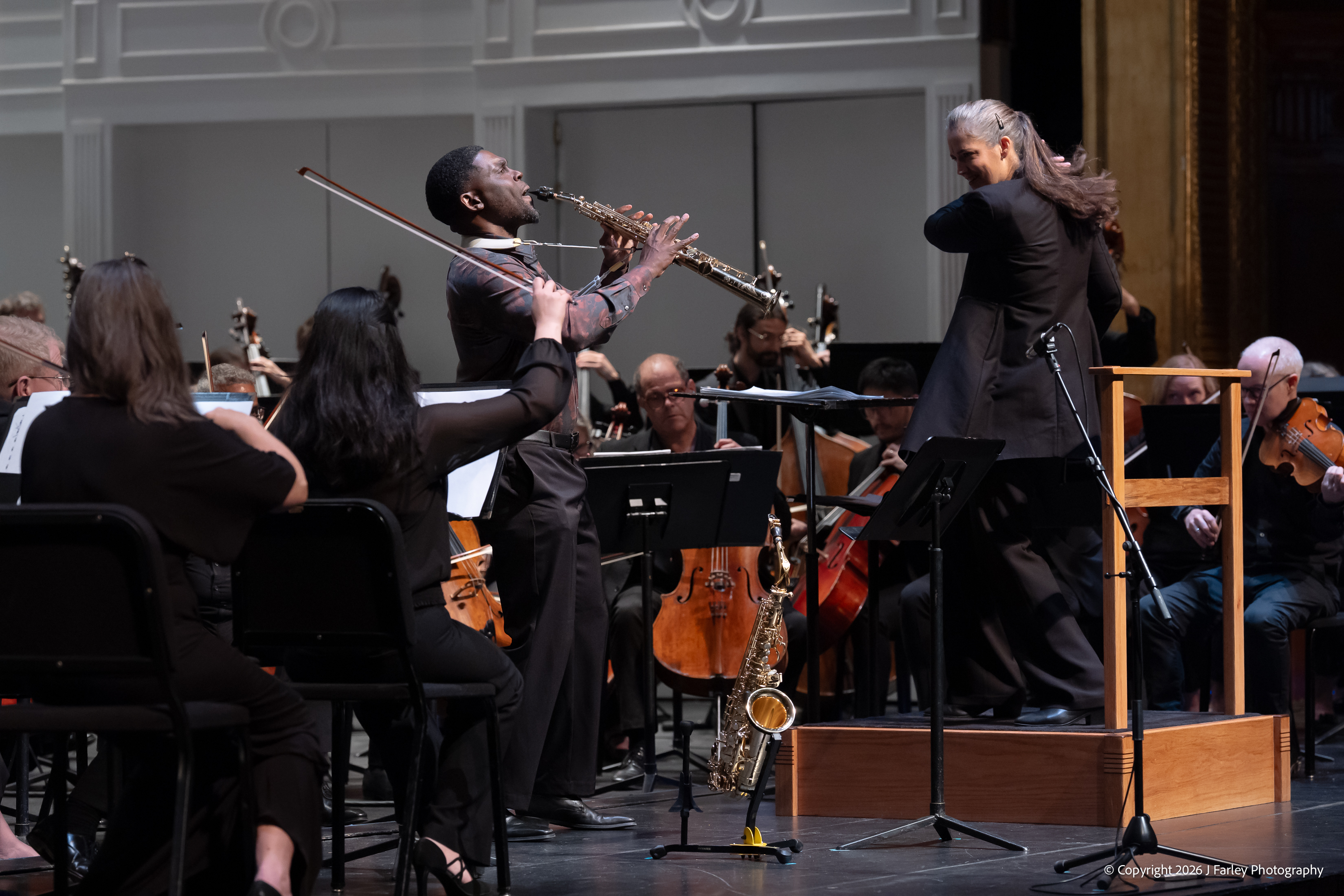
Saxophonist Robert Young joins the orchestra Sept. 26-27 for a concerto inspired by the jazz innovator, whose musical beginnings took shape in High Point.
WS Chronicle | Staff Report
A century after John Coltrane’s birth, the Winston-Salem Symphony is opening its season with a tribute to a musician whose path to jazz history began in the Triad’s Black community.
The orchestra’s “Gershwin, Rachmaninoff, & Trane” concerts bring saxophonist Robert Young to Reynolds Auditorium on Saturday, Sept. 26, and Sunday, Sept. 27. Music Director Michelle Merrill will conduct the program, which the Symphony has announced as its 80th-season opener.
Coltrane was born Sept. 23, 1926, in Hamlet and moved to High Point as an infant. His centennial fell Wednesday, just days before the performances. He spent his childhood in High Point and began playing saxophone while attending William Penn High School, according to the High Point Museum’s account of his life.
The concert connects that regional history to contemporary orchestral music through French composer Guillaume Connesson’s “A Kind of Trane,” a concerto written in 2015.
The Symphony’s program notes describe a work that draws on Coltrane’s musical ideas and spiritual interests without reproducing his recordings. Its three movements move from a title drawn from Coltrane’s poem accompanying “A Love Supreme” to a lyrical middle section and a finale that brings his rhythmic freedom into contact with the repeated patterns of techno. The solo part calls for alto and soprano saxophones.
Young, an assistant professor of saxophone at UNC Greensboro, has performed the concerto with the Berkeley Symphony. His work also includes collaborations with the PRISM Quartet and the choral ensemble The Crossing, including an appearance on the Grammy-winning album “Gavin Bryars: The Fifth Century.”
For Triad audiences, the Coltrane connection reaches back to the schools, churches and community music-making that helped shape his early life.
The High Point Museum places his childhood within both the restrictions of segregation and the support of the city’s Black community. His grandfather, the Rev. W.W. Blair, was a presiding elder in the AME Zion Church. Coltrane joined a community band in 1939 and became a founding member of William Penn’s school band the following year. By his senior year, classmates had voted him “most musical.”
After graduating in 1943, he followed his mother to Philadelphia to continue his musical development.
His career would include work with Dizzy Gillespie, Miles Davis and Thelonious Monk, followed by recordings under his own leadership that included “Blue Train,” “Giant Steps,” “My Favorite Things” and “A Love Supreme.” His music developed through increasingly open approaches to harmony and improvisation, with spiritual expression becoming a central part of his work.
The Symphony pairs Connesson’s tribute with George Gershwin’s “Symphonic Portrait on Porgy & Bess,” arranged by Robert Russell Bennett, and Sergei Rachmaninoff’s “Symphonic Dances.”
Performances begin at 7:30 p.m. Saturday and 3 p.m. Sunday. The Symphony lists tickets at $28 to $98. Its free preconcert discussion, “The Upbeat,” begins at 6:30 p.m. Saturday and 2 p.m. Sunday in the Judy Voss Jones Fine Arts Center behind the auditorium. Concert information and ticket links are available on the Symphony’s event page.
Reynolds Auditorium is at 301 N. Hawthorne Road in Winston-Salem. The Symphony provides parking and arrival directions online.